Digital marketing strategies today are driven by data, analytics, and measurable performance indicators. best digital marketers track clicks, impressions, conversions, and referral sources to understand consumer behavior and optimize campaigns. However, a large portion of online sharing happens outside the visibility of traditional analytics tools. This invisible still powerful form of sharing is known Dark Social Optimization.
Dark Social refers to content shared through private communication channels such as messaging apps, email, direct messages, and closed online communities. Although these interactions significantly influence purchasing decisions and brand awareness, they are often misattributed or completely untracked. As a result,Dark Social Optimization has become an essential concept in modern digital marketing.
Understanding Dark Social
The term Dark Social was coined in 2012 to describe web traffic that originates from private sharing methods. These channels include platforms such as WhatsApp, Telegram, Facebook Messenger, Instagram DMs, email forwarding, SMS, and private Slack or Discord groups.
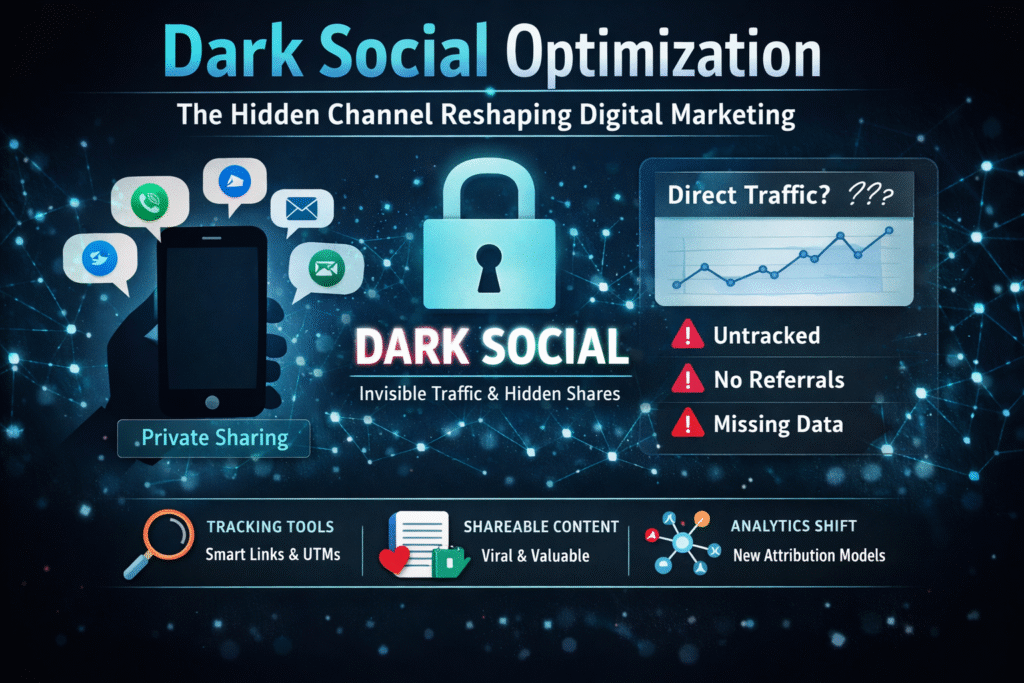
When a user copies a link and shares it privately, the referral data is usually lost. As a result, analytics tools categorize this traffic as “direct,” even though it did not come from users typing the URL manually. This makes Dark Social difficult to measure but impossible to ignore.
Why Dark Social Is Growing Rapidly
1. Rise of Private Communication
Consumers are increasingly shifting from public social networks to private messaging platforms. Private conversations offer more authenticity, privacy, and trust, making them ideal for sharing recommendations and valuable content.
2. Privacy-First Digital Behavior
With stricter data privacy regulations and the decline of third-party cookies, users are becoming more conscious of how their data is tracked. Private sharing naturally matches with this privacy-first mindset.
3. High Trust and Intent
Content shared through Dark Social channels is usually recommended by someone the receiver trusts. This trust increases the likelihood of engagement, conversion, and brand loyalty.
Impact of Dark Social on Marketing Analytics
Dark Social presents several challenges to traditional marketing measurement:
- Overreported direct traffic
- Underestimated social media influence
- Inaccurate attribution models
- Difficulty evaluating campaign performance
As a result, marketers may mistakenly deprioritize content or platforms that are actually driving significant engagement through private sharing.
What Is Dark Social Optimization?
Dark Social Optimization is the strategic approach of designing content and campaigns to encourage private sharing while using alternative methods to measure its impact. Instead of attempting to fully track Dark Social activity, marketers focus on maximizing its value.
The goal is not complete visibility, but better understanding and intentional participation in private digital conversations.
Key Strategies for Dark Social Optimization:
1. Create Highly Shareable Content
Content that performs well in Dark Social environments is typically:
- Educational (guides, tutorials, explainers)
- Emotional (stories, opinions, relatable experiences
- Practical (checklists, templates, solutions)
People share content privately when they believe it will genuinely help someone else.
2. Use Trackable Links and Sharing Tools
Marketers can gain partial insights by using:
- UTM parameters
- URL shorteners
- “Copy link” buttons
- Messaging-app share buttons
These tools do not eliminate Dark Social but provide valuable data signals.
3. Optimize Content for Messaging Platforms
Dark Social content should be optimized for mobile and quick consumption. This includes:
- Clear headlines
- Short summaries
- Easy-to-read formatting
- Visual preview
4. Improve Attribution Models
Marketers should move beyond last-click attribution and adopt:
- Multi-touch attribution
- Engagement-based analysis
- Time-decay models
These approaches better reflect the influence of untracked sharing.
5. Collect Qualitative Insights
Simple feedback mechanisms such as surveys or “How did you hear about us?” questions often reveal Dark Social touchpoints that analytics tools miss.
Dark Social vs Traditional Social Media
Traditional social media relies on public visibility, algorithms, and measurable engagement. Dark Social, on the other hand, performs well on private conversations and human trust.
While traditional platforms help brands reach large audiences, Dark Social often delivers deeper engagement and higher conversion intent
Challenges of Dark Social Optimization:
Despite its importance,Dark Social Optimization has limitations:
- Limited measurement accuracy
- Lack of standardized metrics
- Difficulty proving ROI
- Dependence on inferred data
However, ignoring Dark Social can lead to incomplete and misleading marketing insights.
The Future of Dark Social in Digital Marketing
As digital spaces become more crowded and users seek meaningful interactions, Dark Social will continue to grow. Future marketing strategies will emphasize trust-based engagement, community-driven growth, and content designed for conversations rather than algorithms.
Brands that recognize and adapt to Dark Social early will gain a competitive advantage in a privacy-focused digital landscape.
Conclusion
Dark Social is no longer a hidden or secondary channel it is a dominant force reshaping how information spreads online. While it may never be fully measurable, it can be strategically optimized.
By creating share-worthy content, adopting smarter attribution models, and embracing private communication channels, marketers can unlock the true potential of Dark Social. In an era where trust matters more than reach, Dark Social Optimization is becoming a core pillar of effective digital marketing.